


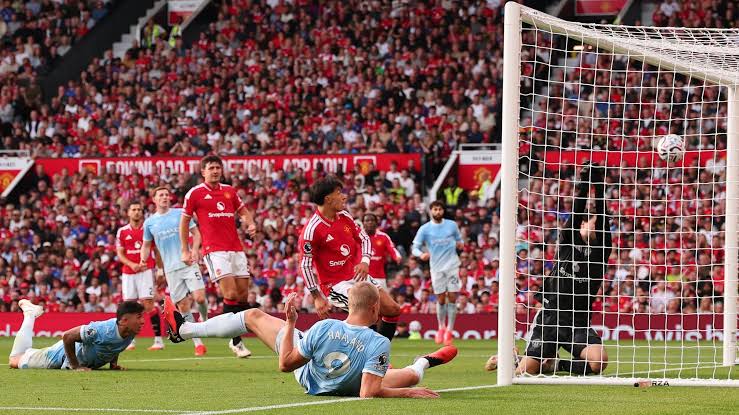
The Haaland VAR controversy has taken another turn after officials released the audio from the Manchester derby incident involving Manchester City and Manchester United.
Manchester City claimed a dramatic 1-0 victory over their local rivals, with Erling Haaland scoring the only goal of the game. However, the goal quickly became the centre of controversy after the officials initially flagged the striker for offside.
VAR subsequently determined that Haaland himself was actually in an onside position when the ball was played.
The problem came from another player involved in the attacking move. Enzo Fernandez was in an offside position and was considered by refereeing authorities to have interfered with Manchester United’s defence.
Despite checking the situation, VAR officials did not overturn the goal.
The error has since been acknowledged by Pro Ref, while the VAR officials involved have been stood down.
What Happened During the Haaland VAR Controversy?
The incident occurred during a fiercely contested Manchester derby.
Haaland found the back of the net, but the assistant referee immediately raised his flag for offside.
That decision meant the goal initially appeared to have been ruled out.
VAR Matt Donohue then began reviewing the decision.
His initial check established that Haaland was actually onside, meaning the original offside call against the Manchester City striker was incorrect.
However, that was not the only part of the attacking phase that needed to be examined.
Fernandez was in an offside position during the build-up and was close enough to the Manchester United defence to potentially affect the play.
According to Pro Ref, the failure to properly assess Fernandez’s involvement was the key mistake.
Haaland Was Actually Onside
One of the most important details from the review is that Haaland himself was not offside.
The VAR team checked his position carefully and determined that the Manchester City striker was onside.
That meant the original on-field offside decision against Haaland needed to be changed.
However, VAR also has to consider the wider attacking possession phase rather than simply checking the position of the goalscorer.
This is where the controversy developed.
The officials continued their review but ultimately concluded that there was no relevant touch from Fernandez.
The goal was then confirmed.
Full VAR Audio From the Incident
The released conversation provides an insight into how the officials reached their decision.
The discussion began with the officials identifying Fernandez during the attacking sequence.
Assistant VAR Blake Antrobus:
“Enzo, Enzo.”
Referee Michael Oliver:
“Deflection.”
VAR Matt Donohue:
“Possible offside.”
Assistant referees Stuart Burt and Tim Wood:
“I’m going to go offside, Haaland.”
Referee Michael Oliver:
“On-field decision is offside.”
VAR then began checking Haaland’s position.
VAR Matt Donohue:
“Checking the on-field decision of offside against Haaland. He’s tight. He’s onside, so now we need to check the full attacking possession phase.”
The officials then went further back into the move to determine whether Iliman Ndiaye was onside when the ball was flicked.
VAR:
“Michael, Haaland’s in an onside position, but I need to check the full APP now, standby. Go back to check if Ndiaye is onside when it is flicked.”
After checking the earlier part of the attacking move, VAR determined that there was no issue with Ndiaye’s position.
VAR:
“Quick, quick. Yes, it’s fine, so it should be a goal. Let’s go, go, go.”
The officials then examined Fernandez’s involvement.
VAR:
“No touch there from Enzo Fernandez, confirm no touch. Clear gap.”
The VAR team ultimately concluded that Fernandez had not touched the ball.
VAR:
“It’s not a touch there, is it? Goal.”
VAR then instructed the referee to change the original decision.
VAR:
“Michael, confirming that you need to change your decision to goal. Haaland is in an onside position. Final decision is goal. Check complete.”
The goal was subsequently awarded.
Why Was the Goal Controversial?
The central issue was not Haaland’s position.
The VAR review correctly determined that Haaland was onside.
Instead, the controversy surrounded Fernandez and whether his position affected the Manchester United defence or goalkeeper.
A player can be penalised for being offside even without touching the ball if they interfere with an opponent or otherwise become involved in the play under the relevant offside laws.
Pro Ref later acknowledged that Fernandez was in an offside position and indicated that he almost certainly interfered with Manchester United’s defence.
That made the decision to allow the goal particularly contentious.
Howard Webb Admits Refereeing Error
Howard Webb, Pro Ref’s chief refereeing officer, addressed the incident on the Premier League’s Mic’d Up programme.
Webb acknowledged that the officials had made an error.
He explained that while Haaland had been incorrectly flagged for offside, the subsequent VAR review correctly established that the striker was onside.
The problem was that the review did not properly consider Fernandez’s involvement in the play.
Webb described the outcome as disappointing and said the officials involved were personally affected by the mistake.
The VAR officials were subsequently stood down until after the international break.
VAR Officials Were Stood Down
Following the incident, Matt Donohue and Blake Antrobus were removed from officiating duties for a period.
The decision came after Pro Ref formally acknowledged that the wrong outcome had been reached.
The move demonstrated the seriousness with which the refereeing body viewed the mistake.
Webb also explained that Pro Ref had contacted Manchester United to acknowledge what happened.
The organisation also provided the club with the relevant footage and audio from the VAR room.
Pro Ref Reviews What Went Wrong
The incident has also prompted a review of the VAR process.
According to Webb, Pro Ref wanted to establish exactly which parts of the decision-making process had failed.
The review is intended to determine why the officials identified the relevant attacking phase but did not arrive at the correct conclusion regarding Fernandez’s involvement.
VAR reviews are designed to correct clear and obvious errors, but they still depend on officials correctly interpreting what they see.
In this case, the initial offside decision against Haaland was corrected, but another element of the same attacking sequence was missed.
The Importance of the Full Attacking Phase
One of the most interesting aspects of the Haaland VAR controversy is the reference to the “full attacking possession phase.”
When VAR checks an offside decision, officials may need to go further back in the move to determine when the relevant attacking phase began.
That means checking more than the position of the player who ultimately scores.
In this case, VAR checked Haaland and then went back to assess Ndiaye.
The officials also discussed Fernandez.
However, the final decision focused on whether Fernandez touched the ball rather than whether his position interfered with Manchester United’s players.
That distinction became central to the controversy.
Manchester United Left Frustrated
For Manchester United, the decision was particularly damaging because the goal decided the derby.
The match ended 1-0, meaning Haaland’s goal was the difference between the two sides.
Had the goal been disallowed, the outcome of the match could obviously have been different.
However, it is important to distinguish between the confirmed refereeing error and speculation about what the final result would have been had the correct decision been made.
The only confirmed point is that the goal was allowed to stand and Pro Ref later acknowledged an error in the process.
Haaland’s Goal Stands Despite the Error
Despite the controversy, the official result remains unchanged.
Manchester City were awarded the goal and recorded a 1-0 victory over Manchester United.
Haaland therefore remains the scorer of the winning goal in the official match record.
The subsequent admission from Pro Ref does not alter the result.
Instead, it has prompted discussion about how VAR officials should assess potential interference during offside reviews.
What Howard Webb Said About the Incident
Webb also emphasised that referees and VAR officials take pride in their work.
He said the officials were disappointed with the outcome and that they understood they had fallen short in this particular situation.
He also stressed the importance of transparency.
Pro Ref’s decision to release the audio and explain the incident publicly was intended to show how the review unfolded and identify where the process went wrong.
The full transcript provides supporters with a rare look into the communication between the referee and VAR team during a controversial Premier League incident.
Why the Audio Matters
VAR conversations are normally hidden from supporters during matches.
That makes the release of the audio particularly useful for understanding how officials reach decisions.
In this case, the conversation shows that the VAR team did not simply ignore Fernandez.
His presence was identified during the review.
The controversy is that the officials ultimately decided that he had not committed an infringement because they focused on whether he had touched the ball.
That is why the transcript has attracted so much attention.
The Haaland VAR Controversy Explained
In simple terms, there were several separate stages to the incident:
- Haaland was initially flagged offside.
- VAR checked his position.
- Haaland was found to be onside.
- VAR checked the wider attacking possession phase.
- Ndiaye was checked and found to be onside.
- Fernandez’s involvement was discussed.
- VAR determined that Fernandez had not touched the ball.
- The goal was awarded.
- Pro Ref later acknowledged that Fernandez had interfered with the Manchester United defence.
- The VAR officials involved were stood down.
The controversy therefore was not about whether Haaland was offside. It was about whether another player affected the play while in an offside position.
Final Thoughts
The Haaland VAR controversy has provided another major talking point about the use of technology and decision-making in football.
The VAR team correctly overturned the original offside decision against Haaland after establishing that the Manchester City striker was onside.
However, Pro Ref later acknowledged that the officials failed to properly account for Fernandez’s involvement while he was in an offside position.
The released audio shows that Fernandez was identified during the review, but the officials ultimately focused on whether he touched the ball before confirming the goal.
Howard Webb has since acknowledged the mistake, while the VAR officials involved have been stood down temporarily.
For supporters, the release of the conversation offers a detailed look at how one of the most controversial moments of the Manchester derby unfolded inside the VAR room.